Showing posts with label What's in Our Collection?. Show all posts

Monday, October 14, 2013

Nautical Art: Scrimshanders and their Scrimshaws

At the height of the whaling industry during the 18th and 19th centuries, the art of producing scrimshaw became prominent among whalermen and sailors. Simply put, scrimshaw “is the art of carving on ivory, bone, woods and shells.” [1] Some experts believe that any piece produced after 1900 is no longer considered a scrimshaw or, more narrowly, that a piece is only considered a scrimshaw if produced by whalermen. Others believe that a scrimshaw just needs to “have a nautical association in respect to one or more of the following: maker, motif, method, or materials.” [2] This art form is by no means exclusive to this time period, nor is it exclusive to whalermen and sailors. In fact, these whalermen brought this art form to the west coast where the Eskimos were exposed to the new technique. The Eskimos have a long history of using walrus ivory which they then combined with these new scrimshaw techniques. Scrimshanders, or the makers of scrimshaw pieces, still practice this art form today.

Modern laws on ivory trading and the protection of marine life, along with increasing numbers of counterfeits, make it even rarer for one to come into possession of an authentic scrimshaw. With this in mind, the San Diego Maritime Museum has been fortunate to receive a donation of an extensive scrimshaw collection from the Norman C. and Jeanne M. Bunker Trust. Mr. Norman C. Bunker is a dentist in California with an interest in collecting scrimshaws. This collection consists of 47 pieces of scrimshaw in excellent condition. Although all the pieces of the collection are outstanding, a few notable pieces stand out.

HMS Victory
by William Gilkerson
The first, and most valuable, piece of this collection is the HMS Victory created by William Gilkerson, a famous scrimshander. This piece of  whale ivory measures seven inches in length and three inches wide. The front of the scrimshaw was first created with the image of the front (or bow) of the HMS Victory. It was then placed into an exhibit at the San Francisco Maritime Museum, at which Mr. Bunker purchased it. Mr. Bunker later commissioned Gilkerson to complete the backside of the scrimshaw with the image of the rear (or stern) of the HMS Victory. Further, this scrimshaw comes along with a wooden stand that was made from a piece of the original pasture oak removed from the lower hold of the ship during repairs in 1953.

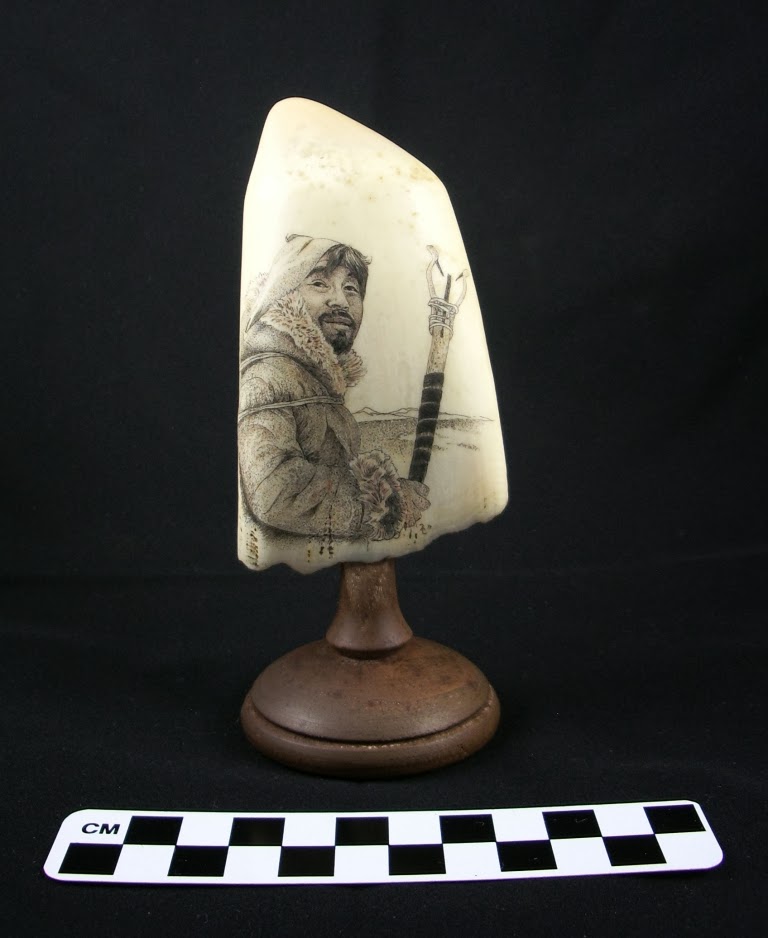
Eskimo on walrus ivory

The next piece is a good example of how the Eskimos have been influenced by the art of scrimshaw. This piece was made with walrus ivory and measures five and a half inches in length and two and a half inches wide. The technique used is similar to most of the other pieces in this collection while the image is distinctly Eskimo.

Metal picks with a
different whale on each handle


A remarkable set of six metal picks with bone handles is a great example of how scrimshaw does not only consist of whole pieces of whale ivory or bones, but are sometimes made into more creative pieces. These metal picks are relatively small in size, measuring around 5 inches in length and half an inch wide. This small size makes the intricate carvings all the more impressive. On each of the six bone handles, an image of a whale is carved onto one side, with different whaling tools carved onto the other. The images of the whales include (from left to right): a sperm whale, a humpback whale, a killer whale, a right whale, a blue whale, and a sulphur bottom whale.

Dagger with reindeer scene
Another more creative piece of scrimshaw in this collection is the dagger with a handle made of whale bone that comes in a dagger sheath also made of whale bone. This piece measures around 8 and a half inches in length and 1 inch wide. On both parts of this beautiful piece, scenes with reindeers are carved onto the bone.
One of two scrimshaws made
with the dotting technique

Lastly, a distinct pair of scrimshaw, possibly dating back to the period of the Godey Lady, stands out because of the technique used to carve the image onto the whale ivory. Both pieces measure around 6 inches in length and 2 inches wide. Normally, the scrimshander would connect the dots or directly carve lines onto the ivory. The images on both pieces are clearly seen to have been outlined by dots and left as is. They were then filled in with some color. Of all 47 pieces in this collection, only these two pieces were produced with this technique.


While the whalermen and sailors of the 18th and 19th centuries viewed the art of scrimshaw as a way to pass time out in the open sea, modern scrimshanders today view this art form as a way to respect the sea and to keep this great tradition alive. Karl Kortum, the Director of the San Francisco Maritime Museum, said it best: “The old scrimshaw was an escape from the sea – from too much sea – back towards the land. The new scrimshaw moves in the other direction.” [3]    

Entry prepared by Samantha Chu, Collections Intern.

Friday, June 28, 2013

Travel in a Different Era: The George Foster Collection

George M. Foster (1914-2006) was a distinguished anthropologist and, among his many accomplishments, has been called the founder of medical anthropology. It is somewhat surprising then to walk back into the archives and see three boxes and a full filing cabinet attributed to Dr. Foster. He was clearly a man of many passions, one of which included collecting various documents and ephemera relating to steam liners of the 20th century. The three archive boxes work together to create a very detailed manifest of the biggest and more popular liners. A large catalogue filled with hundreds of detailed entries is only an introduction to the vast amount of information available in this collection. Working in concert with this book are two scrapbooks of postcards, newspaper clippings and reproduced pictures. These images often relate to an entry in the book full of liners, providing more detailed or even color pictures of the numerous ships. All of these books are extremely informative and begin to tell a story of an era when the traveling was an experience in and of itself – a phenomenon that is becoming less and less the case.
Brochures for S.S. Ile de France, moving away from numbered classes.
              Further illustrating this time period in travel is the extensive amount of documents – brochures, menus, deck plans and other ephemera – related to ship lines and occasionally to individual ships. This is a hefty percentage of the collection – there are more than 300 folders filled with these artifacts, spanning the 20th century and from all around the globe. Ship brochures advertised travel in a way that would, today, only be reserved for a website about a cruise line. These colorful and image-filled documents give the reader a feeling of the atmosphere on a ship as well as a sense of familiarity – the detailed deck plans are sometimes even printed into the brochure booklet. It is often the case in this day and age that one doesn’t spend more than about five minutes choosing their seat on an airline’s website, but it is clear that the process of choosing and purchasing a cabin on a ship was much closer to buying a house or leasing an apartment than it is to modern travel. Advertisers understood this, too. Many of the brochures and pamphlets in this collection refer to one’s “personal palace,” as with the S.S. Empress of Britain, or “making the Ile your home,” in the case of the S.S. Ile de France. Luxury and prestige was key, second only to comfort.
Grouping of items from Foster's voyage on the RMS Queen Mary.
            There is no indication in this collection that George Foster personally traveled on all of the lines and ships for which he collected a file, but there are some to which he did have a personal connection. The R.M.S. Queen Mary (Cunard Line) was one such vessel. The file on this ship is particularly interesting as there are documents from an actual voyage – one on which George Foster and his family traveled in 1961. There is a daily itinerary, including information on specific events, announcements, and puzzles such as one would find in a daily newspaper. Menus from lunch and dinner also indicate restaurant-level quality not only on a daily basis, but also multiple times a day. These menus are for the 2nd class travelers – which by this time many lines had begun calling “Tourist Class” – and with no 1st class information, it is difficult to fully know the difference between the two in this case. Despite the fact that Dr. Foster did not travel on every ship about which he has information, there is a personal touch throughout this collection. Notes on specifics of ships throughout the catalogue and handwritten tidbits of information throughout speak to the care and attention to detail these artifacts possess, making these artifacts a critical – and colorful – addition to this museum.

For more information on George Foster, visit: http://senate.universityofcalifornia.edu/inmemoriam/georgemfosterjr.htm