Showing posts with label Steam Liners. Show all posts

Thursday, July 18, 2013

Ferryboat Berkeley Notices

The maritime museum itself is set up inside the Berkeley. There are numerous exhibits on the different areas of maritime history and fishing in the southern California area.
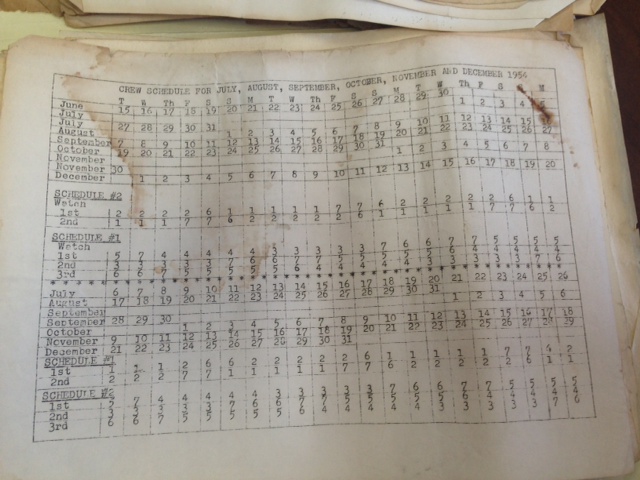
Crew Schedule
What some people might forget is that this boat was a working ferry at one point in history. She served for 60 years in the San Francisco Bay area. She was the first successful propeller driven ferryboat on the West Coast, and she also helped to rescue victims from the San Francisco earthquake fire in 1906. She steamed between Oakland and San Francisco on a normal basis. The Berkeley was purchased by the museum in 1972.

The archive room sits in the back of the library, full of historical documents about the submarines and boats that are here at the museum. We are working on replacing some of the notices in the pilot house of the Berkeley and came across some interesting documents from the steam days of this boat.


First Class Ticket
There are multiple engineer records, passenger logs, and notices sent out from the Southern Pacific Railroad Company. Each document is a look into the past of this boat. 

This is a first class ticket for the ferryboat leaving from San Francisco on July 29, 1958. This happened to be one of the last voyages the ferryboat would make. The cost was $100. 

Some of the notices went into detail about accidents that occurred on the ferryboat. One involved a mother and her two children attempting to get off of the boat. The gate was down, but had separated from the boat. She had to drop her belongings into the water in order to catch her children before they fell into the water. Another notice titled "Notice No. 4," came on July 14, 1950: "It is necessary for the captain to report to the United States Coast Guard all cases of person overboard, whether the person's life was saved or not." 

Important information for the time
In 1955, the ferryboat had been taken out of service to get some work done to the hull. The Southern Pacific Railroad Company sent this notice to the captain before it left Oakland on May 10: "As you know, the boat is back in service after being dry docked and having her hull cleaned and painted.  This will make it harder for her to stop quickly. Take notice of this when docking in San Francisco." 

These are just a few of the notices from the library archives. For more information about ferryboat Berkeley, visit the museum or check out our website, Maritime Museum of San Diego. 

Entry prepared by Leslin Ossoff, Collections Intern. 


Friday, June 28, 2013

Travel in a Different Era: The George Foster Collection

George M. Foster (1914-2006) was a distinguished anthropologist and, among his many accomplishments, has been called the founder of medical anthropology. It is somewhat surprising then to walk back into the archives and see three boxes and a full filing cabinet attributed to Dr. Foster. He was clearly a man of many passions, one of which included collecting various documents and ephemera relating to steam liners of the 20th century. The three archive boxes work together to create a very detailed manifest of the biggest and more popular liners. A large catalogue filled with hundreds of detailed entries is only an introduction to the vast amount of information available in this collection. Working in concert with this book are two scrapbooks of postcards, newspaper clippings and reproduced pictures. These images often relate to an entry in the book full of liners, providing more detailed or even color pictures of the numerous ships. All of these books are extremely informative and begin to tell a story of an era when the traveling was an experience in and of itself – a phenomenon that is becoming less and less the case.
Brochures for S.S. Ile de France, moving away from numbered classes.
              Further illustrating this time period in travel is the extensive amount of documents – brochures, menus, deck plans and other ephemera – related to ship lines and occasionally to individual ships. This is a hefty percentage of the collection – there are more than 300 folders filled with these artifacts, spanning the 20th century and from all around the globe. Ship brochures advertised travel in a way that would, today, only be reserved for a website about a cruise line. These colorful and image-filled documents give the reader a feeling of the atmosphere on a ship as well as a sense of familiarity – the detailed deck plans are sometimes even printed into the brochure booklet. It is often the case in this day and age that one doesn’t spend more than about five minutes choosing their seat on an airline’s website, but it is clear that the process of choosing and purchasing a cabin on a ship was much closer to buying a house or leasing an apartment than it is to modern travel. Advertisers understood this, too. Many of the brochures and pamphlets in this collection refer to one’s “personal palace,” as with the S.S. Empress of Britain, or “making the Ile your home,” in the case of the S.S. Ile de France. Luxury and prestige was key, second only to comfort.
Grouping of items from Foster's voyage on the RMS Queen Mary.
            There is no indication in this collection that George Foster personally traveled on all of the lines and ships for which he collected a file, but there are some to which he did have a personal connection. The R.M.S. Queen Mary (Cunard Line) was one such vessel. The file on this ship is particularly interesting as there are documents from an actual voyage – one on which George Foster and his family traveled in 1961. There is a daily itinerary, including information on specific events, announcements, and puzzles such as one would find in a daily newspaper. Menus from lunch and dinner also indicate restaurant-level quality not only on a daily basis, but also multiple times a day. These menus are for the 2nd class travelers – which by this time many lines had begun calling “Tourist Class” – and with no 1st class information, it is difficult to fully know the difference between the two in this case. Despite the fact that Dr. Foster did not travel on every ship about which he has information, there is a personal touch throughout this collection. Notes on specifics of ships throughout the catalogue and handwritten tidbits of information throughout speak to the care and attention to detail these artifacts possess, making these artifacts a critical – and colorful – addition to this museum.

For more information on George Foster, visit: http://senate.universityofcalifornia.edu/inmemoriam/georgemfosterjr.htm